Great Moments in Bible History
Number 48
Will History Repeat Itself?
We have been in suspense for several chapters now, wondering what Joseph had in mind as he carefully hid who he really was from his brothers. Perhaps he was just “messing” with his brothers, giving them a taste of what they had given him 20 years earlier. Certainly, the experience had been an emotional roller coaster for them, as he first put them in prison for three days and then on the next visit treated them to a royal feast. As we will see in today’s story, Joseph wanted to learn something about his brothers that he could never learn just by asking.
The story reaches its climax in Genesis 44. This is one of the greatest chapters in the Bible and one of my personal favorites. I have read it many times in the past, but it is still difficult not to get teary-eyed when I read it today.
The chapter begins right after the big feast. Joseph commanded his steward to put the men’s money back in their sacks (the same thing he had done on their first visit) and to put his own silver cup in the sack that belonged to Benjamin. Joseph was setting things up so that it would look like Benjamin had stolen his cup. He let his brothers get a little way out of town, then sent his steward to arrest Benjamin for theft.
When the steward caught up with them and accused them of theft, they were astonished. They explained, “Behold, the money that we found in the mouths of our sacks we brought back to you from the land of Canaan. How then could we steal silver or gold from your lord’s house?” (Genesis 44:8) They were so confident of their innocence, that they added, “Whichever of your servants is found with it shall die, and we also will be my lord’s servants.” When the cup was found in Benjamin’s sack, they were in shock. They tore their clothes (the same thing their father had done 20 years earlier when he thought his son Joseph had been killed by a wild animal) and returned to Joseph’s house. This is the first evidence we have that the brothers have changed in the years since their infamous deed against Joseph. Even though their father’s favoritism for Benjamin was just as bad as his favoritism for Joseph, they obviously care about Benjamin and are not going to abandon him in his time of need.
We saw in the previous chapter how Judah had stepped up to become the leader of his brothers, so he was the spokesman to Joseph on behalf of the brothers. “What shall we say to my lord? What shall we speak? Or how can we clear ourselves? God has found out the guilt of your servants; behold, we are my lord’s servants, both we and he also in whose hand the cup has been found” (verse 16). I doubt that Judah believed Benjamin to be guilty of theft, since the brothers had already seen how their money had amazingly turned up in their sacks. My guess is that when Judah said, “God has found out the guilt of your servants,” he was thinking of their guilt for what they had done to their brother all those years earlier. Even though they were innocent this time, he knew they could never be innocent in God’s eyes.
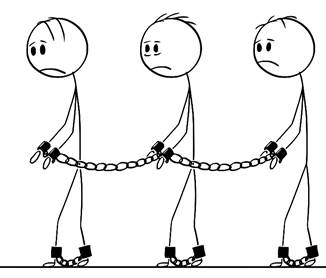
Joseph rejected Judah’s offer that all the brothers would become his slave. “Far be it from me that I should do so! Only the man in whose hand the cup was found shall be my servant. But as for you, go up in peace to your father.” He was carefully setting things up to be a repeat of when they had sold him into slavery. In this case they do not have to do anything underhanded like they had with Joseph. They can simply go home and leave their brother to become a slave. The question Joseph wants answered is, what will they do this time?
Judah responded with one of the truly great speeches in the Bible. He began by reviewing their first visit to Egypt and how Joseph had insisted that they bring their other brother with them the next time they came. He then recounted how difficult it was to convince their father to let Benjamin go with them. He quoted his father, “You know that my wife bore me two sons. One left me, and I said, ‘Surely he has been torn to pieces,’ and I have never seen him since. If you take this one also from me, and harm happens to him, you will bring down my gray hairs in evil to Sheol” (verses 27-29). Even though Jacob had 12 sons, in his mind he only had two. That had been the main reason the brothers had hated Joseph. Jacob had clearly not changed in the years since, but they had. They have forgiven their father and have learned to live with the situation. In fact, they now love their father so much that they refuse to abandon his favorite son in Egypt.
Judah continued, “Now therefore, as soon as I come to your servant my father, and the boy is not with us, then, as his life is bound up in the boy’s life, as soon as he sees that the boy is not with us, he will die, and your servants will bring down the gray hairs of your servant our father with sorrow to Sheol.” Even though this time the loss of Jacob’s favorite son would not really be their fault, they cannot bear to see what it would do to their father.
Judah wrapped up his speech with the most amazing offer. “For your servant became a pledge of safety for the boy to my father, saying, ‘If I do not bring him back to you, then I shall bear the blame before my father all my life.’ Now therefore, please let your servant remain instead of the boy as a servant to my lord, and let the boy go back with his brothers. For how can I go back to my father if the boy is not with me? I fear to see the evil that would find my father.” Judah asked Joseph for the favor of taking his brother Benjamin’s place as a slave! Twenty years earlier it was Judah who came up with the idea of selling Joseph into slavery. Now he offers to become a slave himself to save Benjamin from a similar fate. Wow! There are few people in all of history who have demonstrated a love as sacrificial as that.
A Substitute
Judah’s offer to be a substitute for his brother introduces an important theme in the Bible. The Jews in the Old Testament understood that the animal sacrifices they offered to God were substitutes for themselves (see Leviticus 1:4), but the idea of a human as a substitute was less well known. The best place to learn about it is in the book of Isaiah. That book was written around 700 years before Christ—centuries after Genesis. More than any other Old Testament book it predicts the coming of the Messiah. The word Messiah means “the anointed one.” The New Testament uses the word Christ which means the same thing. Chapter 53 of Isaiah describes how the Messiah will be a substitute for the ones Isaiah refers to as “us.”

“Surely he has borne our griefs and carried our sorrows; yet we esteemed him stricken, smitten by God, and afflicted. But he was pierced for our transgressions; he was crushed for our iniquities; upon him was the chastisement that brought us peace, and with his wounds we are healed” (Isaiah 53:4-5). This describes a much greater substitution than the one Judah offered to be. The Messiah will be a substitute for sinners, taking the punishment for their sins on Himself. “All we like sheep have gone astray; we have turned—every one—to his own way; and the LORD has laid on him the iniquity of us all.”
Unlike Judah’s substitution which would have ended up with him becoming a slave, the Messiah’s substitution for our sins resulted in His death. “By oppression and judgment he was taken away; and as for his generation, who considered that he was cut off out of the land of the living, stricken for the transgression of my people? And they made his grave with the wicked and with a rich man in his death, although he had done no violence, and there was no deceit in his mouth” (verses 8-9).
The substitution of the Messiah for us will result in His death (which is what we deserved because of our sins), but the chapter does not stop there. It talks about His life after that death. “When his soul makes an offering for guilt, he shall see his offspring; he shall prolong his days” (verse 10). This implies that He will be raised from the dead.
Seven hundred years after Isaiah wrote that amazing prediction, Jesus was born. In Matthew 1:3 we learn that He was descended from Judah. How appropriate is that? Judah made his amazing offer to be a substitute and take on himself the punishment that would otherwise fall on his brother. His descendant Jesus became the substitute for us, taking on Himself the punishment we deserved for our sins.
A number of times in the Old Testament, God had someone act out in advance what His Son Jesus would later do. We saw an example of that in Genesis 22 when God told Abraham to sacrifice his son. In today’s lesson Judah offered to do it. In a later issue we will consider Joseph himself and how his life was an acting out in advance of Jesus’ life. These foreshadowings of Jesus in the Old Testament not only give us confidence that God really did write the Bible (How else could you have stories that so clearly predict what Jesus would do?), but they give us an amazing glimpse into the heart of Jesus. We are impressed at Judah’s loving offer. How much more should we be impressed by Jesus?
Scripture quotations are from the ESV® Bible.